Work About Resume
Back to Work
AXLEHIRE (Now JITSU)

Client self-service delivery tracking portal

RoleLead Product Designer
TeamEngineering, Client Success, Operations
Timeline3 weeks
PlatformWeb (Desktop)

AxleHire's enterprise clients — major retailers managing thousands of daily shipments — had no self-service visibility into their delivery operations. Every status check, exception report, and order modification required contacting AxleHire's dispatch team directly. This project designed the company's first client-facing operations portal, giving enterprise customers real-time delivery visibility and automated order ingestion while reducing dispatch support requests by ~80%.

~80%
Reduction in dispatch support requests from enterprise clients
9.7/10
Average customer satisfaction score post-launch
01 — Context & Problem

Enterprise clients flying blind on their own deliveries

From the client perspective
  • No real-time visibility into delivery status across their order volume
  • Exception management required calling or emailing AxleHire dispatch
  • Order ingestion was manual — CSV uploads via email to an ops coordinator
  • Reporting was available only on request, with 24–48hr turnaround
  • No ability to update delivery instructions or address corrections without dispatch
Internal ops pain points
  • Dispatch team fielding 200+ client status inquiries per day
  • Manual order ingestion from CSV was error-prone and time-consuming
  • No audit trail for client-requested order changes
  • Client onboarding took 2–3 weeks due to manual setup processes
Build the portal that makes our clients feel like they're running their own logistics operation.
02 — Discovery & Insights

What enterprise clients actually needed

We ran discovery sessions with 6 enterprise client accounts, ranging from a regional grocery chain to a national furniture retailer. Their operations contexts were very different, but their core needs converged on three themes.

Key Finding 1
Clients didn't need every data point — they needed the right signal. Exception alerts (failed deliveries, address issues, late routes) were more valuable than comprehensive tracking dashboards that required interpretation.
Key Finding 2
Order ingestion was the highest friction point — not visibility. Several clients had dedicated coordinators whose primary job was reformatting order files to match AxleHire's CSV template. Automating this would free significant client-side resources.
Underlying need
Clients wanted to feel in control of their operations, not dependent on a third party for information about their own orders. The portal's emotional goal was autonomy — not just access to data.
03 — Design Principles & Requirements

The constraints that shaped every decision

ClarityInformation architecture optimized for exception identification — not data completeness. Clients should see what needs attention first.
FlexibilityPortable to clients with different order volumes, different workflows, and different technical sophistication levels.
My team's sanityEvery self-service action the portal enables is one fewer support contact for the dispatch team. Design for dispatch reduction.
04 — Design Changes · Change 1

Real-time map view of deliveries

The centerpiece of the portal was a live delivery map showing all active routes, their current status, and any exceptions flagged in real time. Clients could filter by region, client account, date range, and exception type — moving from a high-level overview to an individual delivery in two clicks.
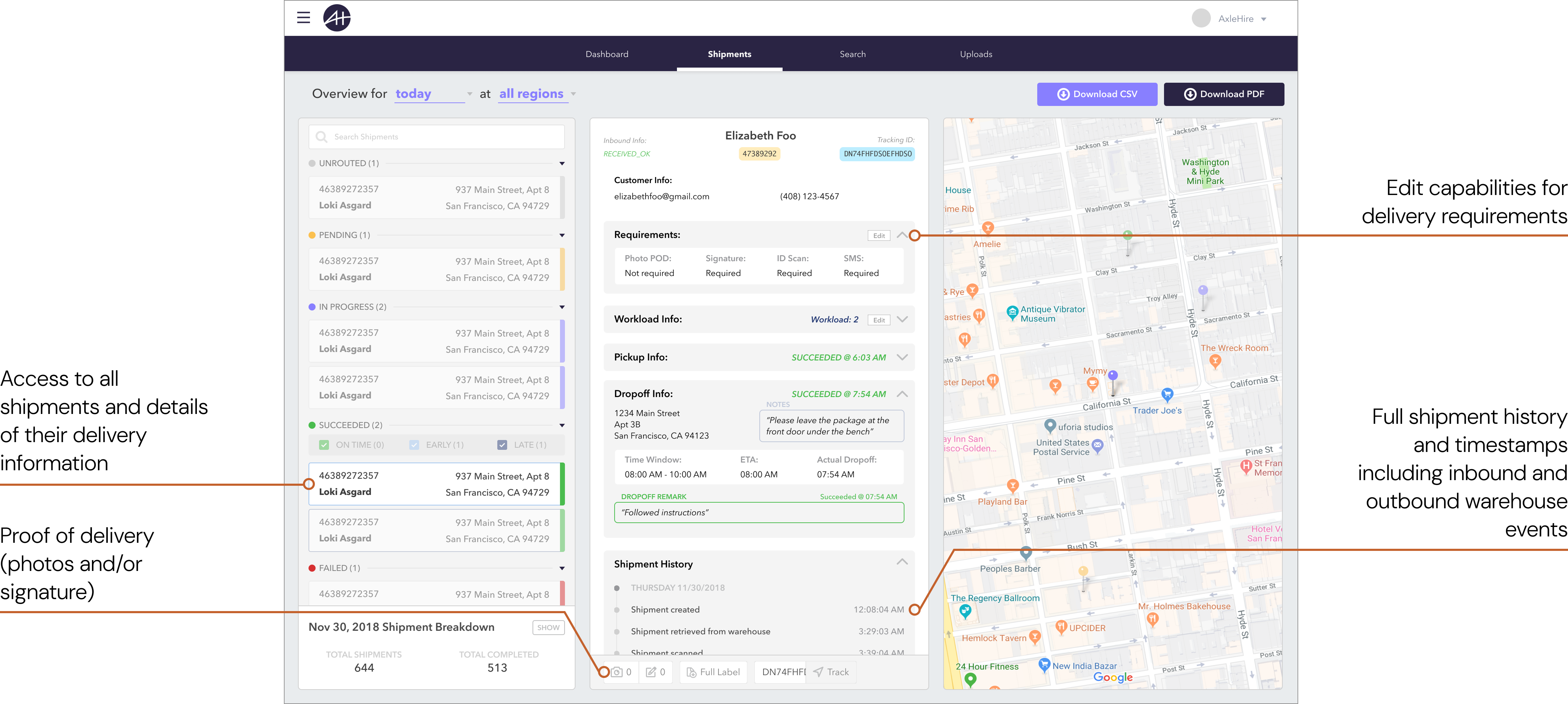
Delivery map with annotations
Impact — Real-time map view
~80%
Fewer inbound client status inquiries to dispatch team
Faster
Exception resolution — clients act on alerts directly without dispatch involvement
04 — Design Changes · Change 2

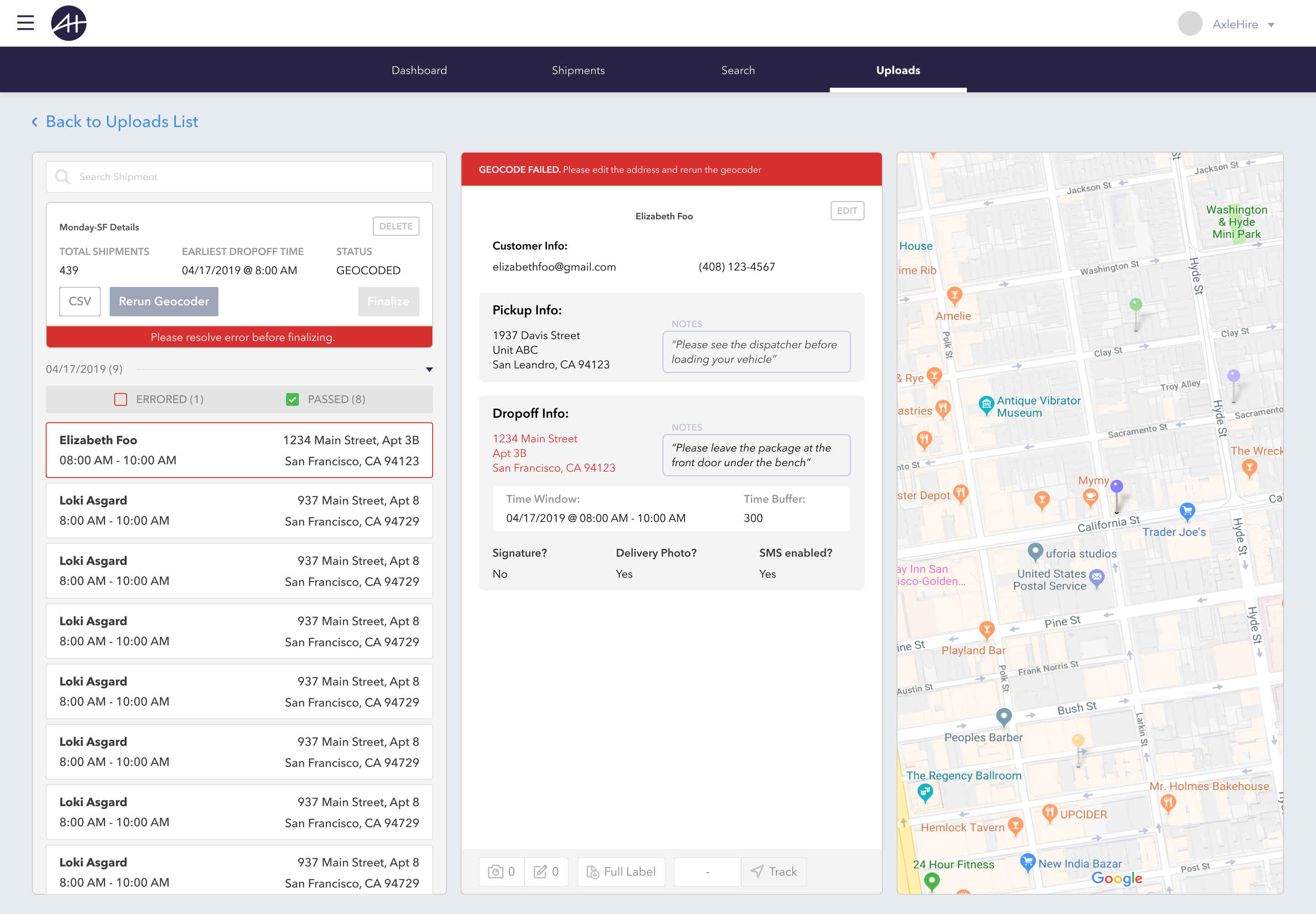
Self-service CSV upload with real-time validation

We designed an order ingestion interface that accepted any CSV format and used field-mapping logic to automatically match client columns to AxleHire's order schema. Unrecognized fields were surfaced for manual intervention. Validation errors appeared inline, per row, before submission.

Impact — Self-service CSV
Automated
Order ingestion — no coordinator involvement for standard uploads
2–3 wks
Client onboarding time reduced to under 1 day for standard integrations
Increased
Client ability to manage their own operations independently
05 — Final Outcomes

What shipping this taught me about enterprise product design

The client portal was the project that taught me how much enterprise product design is actually organizational design. The portal didn't just give clients visibility, it redistributed work that had been sitting entirely on AxleHire's internal ops team. That redistribution had implications for team structure and client contracts that went well beyond any individual screen.

The most unexpected outcome was how much the portal changed the client relationship itself. Clients who previously called daily stopped calling not because they didn't have questions, but because the portal answered them before they could form. Several clients reported that having visibility made them more patient with exceptions, not less. Seeing the operational complexity of last-mile delivery in real time gave them context that phone calls never could.

If I were starting this project over, I would have pushed harder for a dedicated exception management workflow earlier. The map view was powerful, but high-volume clients needed a task-oriented exception queue, not a spatial overview, to manage efficiently.